From Heritage to Motion: Persian Symbols in Contemporary Visual Design
"Exploring how historical Persian symbols, cuneiform inscriptions, and mythological creatures like the griffin are reinterpreted into modern motion design identities."
Symbols can carry meaning far beyond their immediate visual form. A bird, a crown, an animal, or a geometric pattern can become a representation of identity, history, power, or belonging when it is placed within a particular cultural context.
For visual designers, this creates an interesting challenge: how can a historical symbol be translated into a contemporary visual identity without losing the character that made it meaningful in the first place?
This question becomes particularly relevant when working with Persian and Iranian visual heritage, where centuries of mythology, architecture, decorative arts, inscriptions, and heraldic imagery provide a rich source of visual language.
The challenge is not simply to reproduce an old symbol. It is to understand its visual structure and cultural associations, then find an appropriate way to reinterpret it for a contemporary audience.
The Griffin as a Visual Symbol
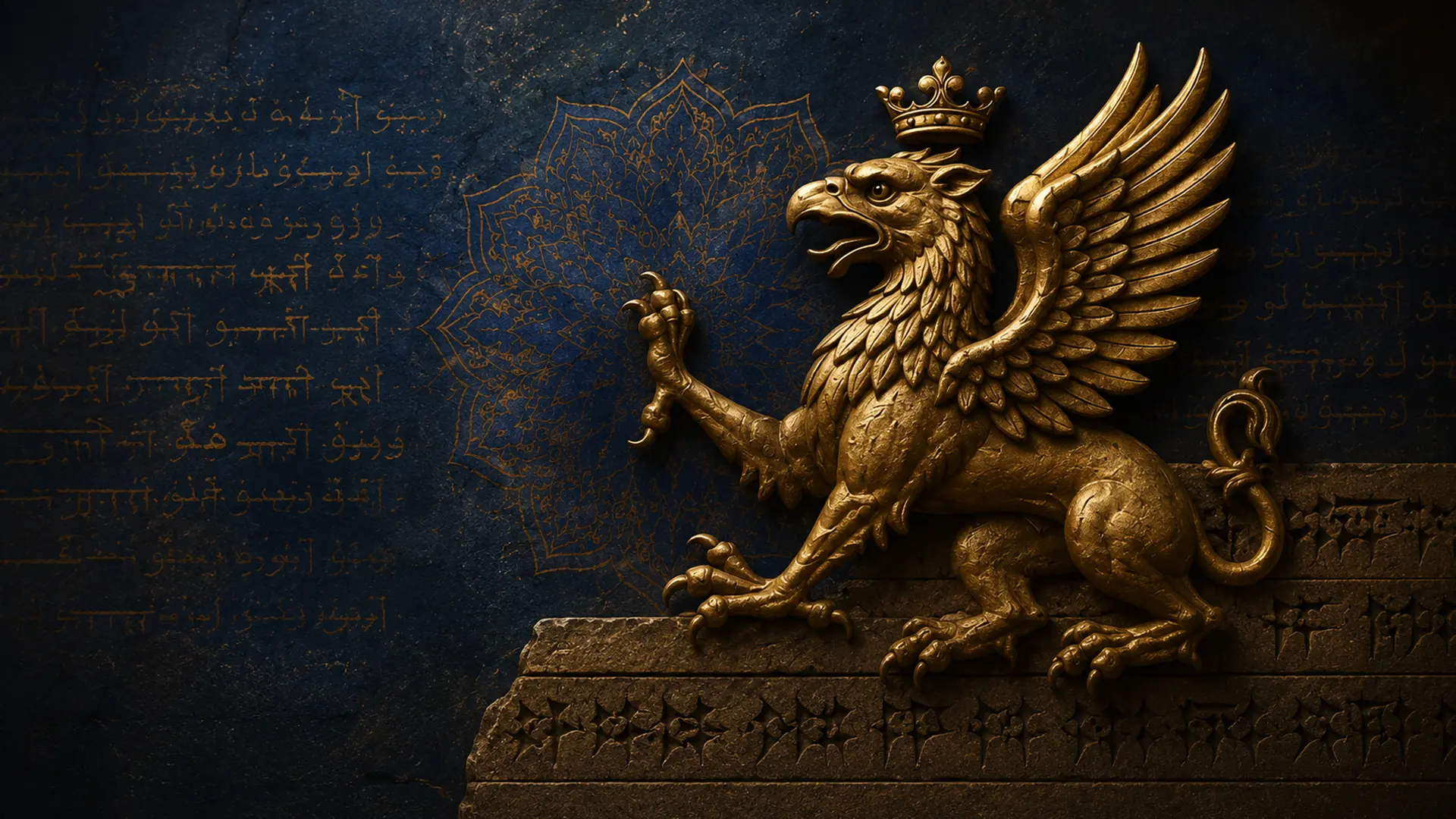
Among the creatures associated with ancient Iranian and Persian visual culture, the griffin is one of the most recognizable.
Traditionally represented as a composite creature combining features of an eagle and a lion, the griffin brings together qualities associated with both animals: the strength and physical power of the lion with the majesty and elevated perspective of the eagle.
Composite creatures of this kind have appeared in the artistic traditions of several ancient cultures, including the broader visual world of the ancient Near East. Their persistence across different periods demonstrates the ability of symbolic creatures to communicate complex ideas through a single recognizable form.
In Persian and Iranian contexts, griffin-like creatures and related composite animal forms can be found across different periods and artistic traditions. Their visual vocabulary wings, claws, powerful bodies, beaks, and symmetrical compositions, also provides designers with strong graphic elements that can be adapted to contemporary identity design.
From Historical Reference to Visual Language
Using cultural heritage in contemporary design requires more than selecting a historical image and placing it on a modern layout. A designer needs to identify what makes the original visual language distinctive.
This can include:
- Silhouette and proportion
- Symmetry and geometry
- Ornamental details and posture
- Typography or inscription
- Color relationships and symbolic associations
These elements can then be simplified, reorganized, or animated without necessarily reproducing the original artwork literally.
This process creates a distinction between historical reproduction and visual reinterpretation. The first attempts to preserve an existing image; the second asks what aspects of the original visual language can continue to communicate meaning in a new context.
For motion design, this distinction becomes particularly important.
When a Symbol Starts Moving
A static emblem communicates through its shape. A motion identity can communicate through both its shape and its transformation.
The way a symbol appears, unfolds, rotates, transforms, or resolves into its final form can become part of its identity. This gives motion designers another layer of visual language to work with.
- A wing can open.
- A silhouette can emerge from darkness.
- A geometric form can assemble itself.
- A traditional emblem can transform into a contemporary mark.
The movement does not have to be complex. In many cases, a carefully designed transformation can communicate more effectively than a sequence filled with visual effects. The goal is to make the movement feel connected to the meaning of the symbol.
Designing a Contemporary Heraldic Identity
Heraldic imagery is particularly interesting for motion design because it is usually built around strong silhouettes and recognizable compositions.
A successful heraldic mark often needs to remain identifiable at different scales. Its main shapes need to work together as a coherent visual structure, while secondary details support rather than obscure the central symbol.
When such a mark becomes animated, these same principles remain important. The animation needs to preserve the identity of the emblem while introducing movement through techniques such as frame-by-frame animation, shape transformation, controlled reveals, compositing, and carefully timed sound design.
Persian Heritage in a Contemporary Context
One of the strengths of Persian visual heritage is the variety of visual systems it offers. Ancient inscriptions, architectural motifs, ornamental patterns, mythological creatures, calligraphic traditions, and symbolic compositions can all provide starting points for contemporary visual development.
However, cultural references become more meaningful when they are used with context. A historical symbol should not be treated simply as an exotic decorative element. Understanding the background of a symbol helps determine which visual characteristics should be preserved, simplified, or reinterpreted.
From Cuneiform to Contemporary Identity
Writing systems can provide another powerful connection between historical heritage and contemporary design. Ancient Iranian inscriptions, including cuneiform writing associated with the Achaemenid period, have a distinctive visual character.
When used responsibly, such references add another layer of meaning to a visual identity. The combination of an emblem and an inscription connects a contemporary design to a specific historical context within a modern visual system.
The Imperial Griffins Project
Imperial Griffins explores this approach through a contemporary motion identity created for a Persian-speaking virtual squadron in DCS World. The project centers on a griffin emblem, using the creature as a visual representation of strength, heritage, and authority.
One of the project's historical references is an inscription associated with Darius the Great and the Achaemenid period, presented in cuneiform. Artafen Studios developed the visual identity as a motion logo, working across logo animation, clean-up, color design, frame-by-frame animation, sound design, compositing, and editing.
See the Imperial Griffins motion logo project to explore the identity, animation, and production work behind the project.
The Role of Research in Visual Design
When working with cultural symbols, research is not separate from design it informs the decisions that shape the final image. Understanding where a symbol comes from changes the way it is drawn and composed.
This research-driven approach is especially useful when historical references are combined with contemporary media such as animation, motion graphics, games, film, and digital branding.
From Symbol to Identity
The most successful cultural references in contemporary design do not necessarily preserve every detail of their historical source. Instead, they identify the essential visual and conceptual qualities of the source and give those qualities a new context.
Through composition, illustration, animation, sound, and motion, heritage becomes more than a reference it becomes part of the visual story.
Reviews & Ratings
User Reviews
A truly insightful and engaging article. Well written, thoughtful, and a pleasure to read.
August 10, 2026Related Journal Entries
The Role of Indigenous Myths in Contemporary Animation
Native legends and archetypes serve as cultural anchors, enabling animation to convey timeless human truths through universal visual language.
From Paper to Motion: How Origami Inspires Visual Design
Exploring how origami geometry, crease patterns, and paper folding principles inform modern 2D animation, motion graphics, and logo transformation.